


Didn’t you hear? There’s a glorious future on the horizon, if only we allow the CEOs of major tech and AI companies to do whatever they want with us and our world.
There’s a lot they want us to sacrifice in the pursuit of that goal: our information environment, human creativity, the quality of our communities, the health of our pocketbooks, and maybe even truth itself. But they’re not stopping there. The glorious AI future must be realized “even if there is temporary job displacement to deal with,” says Perplexity CEO Aravind Srinivas.
Worried about losing your job? Srinivas wants you to see it as an opportunity. “People don't enjoy their jobs” anyway, he assured the All-In Podcast last month. Not to mention everyone being thrown into unemployment can just start their “own mini-business” with the help of the very tools making them redundant.
We could respond to this latest threat of mass job destruction by worrying about what society looks like with so many people out of work while criticizing the CEOs for being so out of touch. I’d say we do the latter either way, but there’s reason to take a pause on the response to claims of widespread unemployment.
Do we really believe the AI future these executives are trying to sell us is going to be realized? Do we really believe their technology is as powerful and transformative as they’re trying to convince us it is? I certainly don’t, and that means it’s unlikely to have the effect on work they want us to be focused on.
There’s historical precedent not to take them at their word, and to believe their grand statements are designed to distract us from what generative AI is being used for in the here and now.
The last AI job hysteria
A little over a decade ago, headlines declared that AI and robotics were poised to wipe out close to half of all jobs. In that moment, the threat wasn’t generative AI. Instead, self-driving cars were supposed to eliminate millions of driving professions in a matter of years and AI was to enable a massive wave of automation that would move beyond the factory and into retail stores and restaurants. Robots were even going to find their way into old-age homes and other short-staffed care sectors.
The response was largely not to ask whether these narratives were realistic or whether the companies were giving us an accurate reflection of what their technologies could do. The concern was how societies were going to deal with such a vast number of people losing their incomes overnight. It was part of the reason the concept of a basic income experienced a resurgence: if so many people would be without an income, the government would have to provide it.
 Paris Marx
But mass job destruction was not what was actually happening. Self-driving cars did not wipe out millions of taxi and trucking jobs, burger-flipping robots remain a novelty, and as North America and Europe were dreaming of the future of robot senior care, Japan was already pulling back from those very technologies. AI and robotics may have taken steps forward, but they were not nearly as powerful as executives wanted the public to believe and news organizations shamefully parroted with little journalistic investigation.
The real effect was not the eradication of millions of jobs, but a more subtle and pernicious transformation of work and workplaces to reduce the leverage of workers and shift that power even further to their bosses. Tech companies took advantage of the desperation in the post-financial crisis labor market to get workers to accept lower pay and fewer rights in exchange for an income, no matter how paltry. Uber and Amazon are emblems of this effort.
Uber pioneered the gig economy, made up of contract workers whose rides, deliveries, or tasks were at the whim of an algorithmically mediated platform. They were not considered employees, did not have easy access to manager, and had little to no control over their pay or their work. The company told them it was liberating them from the oppression of employment to make them their own bosses, while actually trapping them in a more precarious existence. It brings to mind the language used by Srinivas on All-In.
Paris Marx
As Uber’s model was adopted by a growing number of companies, Amazon pursued another strategy. Logistics was central to its business, but it didn’t want to have to deal with the unions that are usually present the sector. It ensured its warehouses were non-union and paid far less than other parts of the industry, then implemented a form of algorithmic management to intensely surveil and control its workers. They may have had employment status, but they were pushed to meet incredibly aggressive targets that resulted in a much higher injury rate than the industry average, frequent turnover, and even penalized them for bathroom breaks.
All this new tech didn’t so much push people out of work. It was used to deskill their professions, push down their pay, and make sure they had far less power when dealing with management. While people talked about basic income, what was really necessary was stronger rights for workers, legislation that stopped what the companies were doing, and a resurgence of union power to push back on how employers were transforming work. The distraction ensured companies could upend labor rights, then leave lawmakers and workers struggling to respond.
Why to be wary of AI job loss
Does that mean no jobs are being lost as new AI tools roll out in workplaces around the world? Not at all. In some professions, it will be a concern. But there’s often a lot more nuance than the usual narratives about AI and job loss suggest. In many cases, workers aren’t so much losing their jobs because the AI has become so powerful, but rather because employers use AI as an excuse to get rid of workers they wanted to fire anyway.
Even then, in many creative fields, where people are losing their jobs, it’s often not the case that the work is being fully handed over to generative AI. Instead, writers and artists are laid off or denied contracts in favor of a process where text or visuals are generated, then a professional is brought in to edit or touch up the work at a lower rate. Once again, it’s not always the eradication of work, but the transformation of how work is done to cut pay and reduce workers’ leverage.
Paris Marx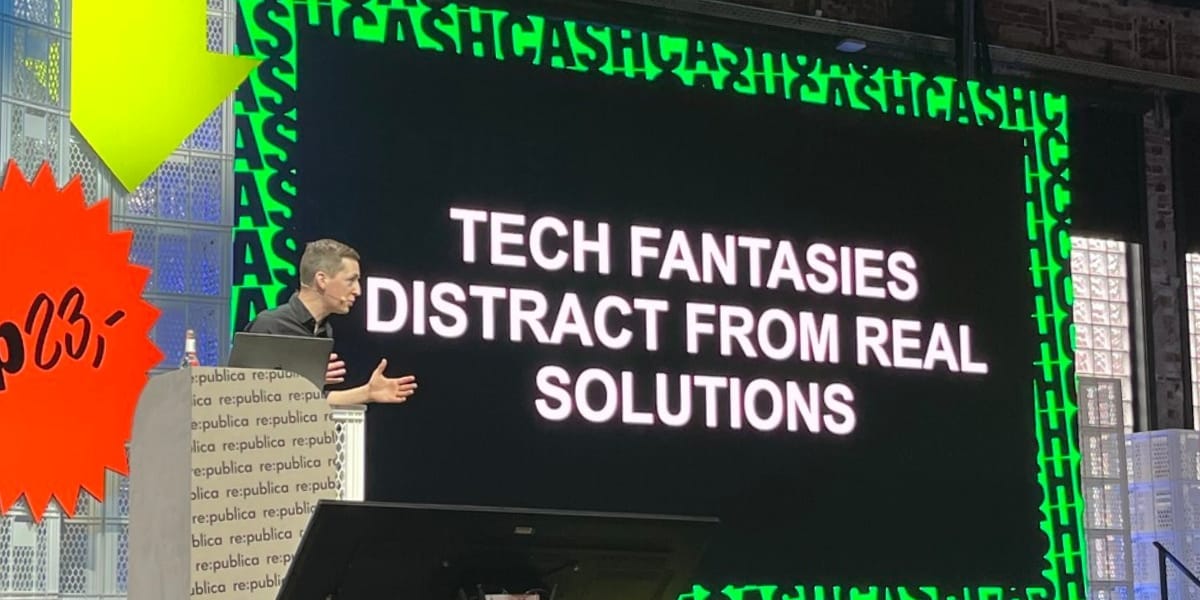
Watching what happened in the mid-2010s helped to shape how I see the tech industry and the narratives it spreads. Tech executives are experts at exaggeration and deception, and all too often their lies shape the public conversation to the companies’ benefit, leaving us ill-prepared to address the real impacts of their business models. A decade ago, I fell for the narratives, but once I saw how work was transformed instead of being destroyed, I never so easily fell for their skillful marketing campaigns again.
Today, as AI CEOs talk about the sacrifices that must be made for a “glorious future,” we should be similarly wary of what effects their products are really having in the world. There’s no question there is a disruption in progress and that generative AI is implicated in it, but the desire of corporate executives to deskill and disempower workers is a far more consequential driver than any new technology.
Humans are not being eliminated from much of this work; their roles are simply being transformed, hidden, and devalued — in the same way capitalists have been doing for hundreds of years. When tech billionaires make bold claims that make their technology is inevitable and revolutionary, we should all take a pause and think about the real intentions behind the exaggeration.


Member discussion