


When OpenAI launched ChatGPT in November 2022, the media and talking heads quickly adopted the company’s mantra that the world had changed. Generative AI was about to revolutionize everything, and that included presenting a challenge to some of the juggernauts that had previously defined the digital economy. None was more at risk than Google, or so they suggested.
Google’s power came from its dominance of search, and now that OpenAI had its own interface for people to find information, Google was supposedly in trouble. Microsoft’s Bing couldn’t steal significant market share from the king of search in the past, but expert commentators were certain that was about to change with ChatGPT. How wrong they were.
In November 2022, Google controlled 92% of the search market. By last month, it hovered around 90%. Not the decimation all those smart tech watchers predicted. That should have been obvious. As I argued at the time, those claiming to foresee a decline of Google had it all wrong: ChatGPT wasn’t a threat to Google; the release of the chatbot by a company outside the top echelons of the tech industry set it free.
 Paris Marx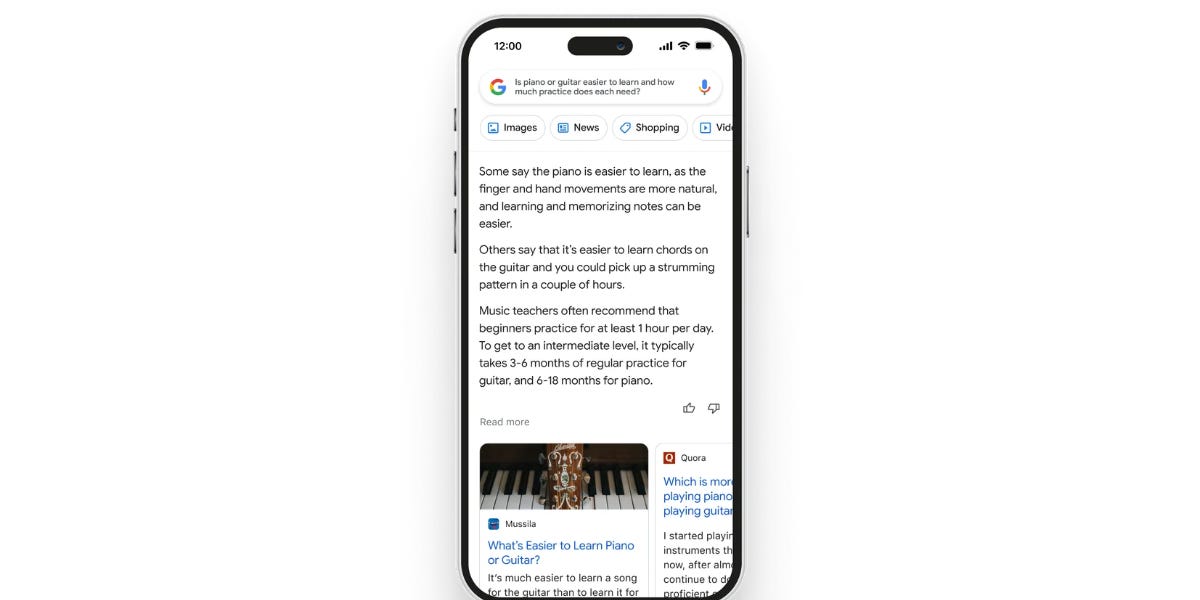
Google had already been experimenting with chatbots, but was hesitant to release them to the world for fear of the public relations disaster that could follow from the responses they might output, and the scrutiny they would attract from regulators. Microsoft had seen that first hand when it released Tay in 2016, only for it to begin echoing the Nazi and racist sentiments of those engaging with it in less than 24 hours. But once OpenAI deployed its “hallucination” machine, the guardrails were off.
Disconnect relies on the support of readers like you. Become a paid subscriber today!
For years, Google had been working to make itself less of a directory and more of a destination in its own right. It didn’t just want to send people to different parts of the web; it wanted them to find the information they were looking for on Google itself. The goal was to get users to spend more time on Google’s website and look at more of its ads, even if that meant they were less likely to visit the websites and news publishers that had come to rely on Google for significant shares of their traffic.
Long before Google introduced AI Overviews, it had added Featured Snippets to its search engine. Those snippets took sections from external websites and displayed them for the user, meaning they might get the answer they were looking for without having to leave Google. It was already a pain point for many publishers, but Overviews took that to the next level.
Instead of just pulling from one source, Google began pulling from many and using its AI tools to output a few paragraphs bringing together tidbits from each of them. Just ignore how the prevalence for the AI system to output false answers — or hallucinations, in industry speak — meant Google was generating millions of inaccurate Overviews every hour. Its ambition was clear: it wanted more users to spend more time on Google and far less visiting other parts of the web.
 Paris Marx
Publishers and website owners began warning of Google Zero as they saw their traffic plummet, but Google didn’t care. It was free to take the next step in destroying their businesses all to serve its own business goals. The company also didn’t care that it was further decimating the kind of information environment a healthy democratic society needs, especially one flooded with AI-generated false information. It’s also one you would imagine a search engine or chatbot that’s supposed to be relaying accurate, up-to-date information relies on.
Google made its ambitions quite obvious in its I/O announcements in 2023. On Tuesday, it laid out the next stage of its plan. The company made it clear there will be no escape from its generative AI products as AI hype continues to grip Silicon Valley, despite public sentiment very clearly turning against it and the data centers needed to power it. Search is the center of Google’s business and its power, and the company is taking a serious risk with the part of its business that drives more than half of its revenue.
While there will still be a box on google.com, it will no longer be a directory to the web. Now it will be the portal to Google’s suite of services, but especially its various generative AI tools it wants to force its users to become reliant on. In part that’s to try to win the AI war against its competitors, but it’s hard not to imagine it’s also a play to build user dependency on generative AI before it has to further jack up its prices.
ChatGPT was never the major threat to Google’s market share that some commentators claimed. In truth, there’s no greater threat to Google’s power and market share than Google itself. Every time Sundar Pichai reconfigures Google products to further force generative AI on users he assumes are hopelessly locked in, he increases the risk they finally throw up their hands and go somewhere else.
Paris Marx
And that’s exactly what Google users should do. There’s no denying that some Google services are more difficult to replace than others — trust me, I’ve been working on it — but for most of them, it’s easier than you might expect. Sure, it will take some adjusting and there will be some moving pains, but unless you want to be forced into the Gemini lifestyle, it’s time to make a plan to get off Google and start packing your virtual boxes for greener pastures.
As I mentioned, I’ve been at this for a while — I wrote a whole guide to help people get off US tech. I replaced Gmail with Proton Mail, started using Qwant to replace Search, dropped Chrome for Vivaldi, experimented with Here WeGo to replace Maps, and replaced a bunch more services with alternatives in the Proton suite: Drive, Calendar, Pass, Authenticator, and most recently Meet. In short, deGoogling is possible if you’re willing to put in the work and accept some compromises. I’m not all the way there, but I’ve made a good dent.
As Google continues to degrade its products in a bid to force us all to rely on Gemini, now is the time to make it feel the consequences of its attempt to strong arm its billions of users. ChatGPT didn’t kill its business, but by acting collectively we can at least put a dent in its armor — if not do much more. It’s worth a shot.
Disconnect relies on the support of readers like you. Become a paid subscriber today!


Member discussion